Thursday, January 15, 2015

MOVIE REVIEW: Bill and Ted's Excellent Adventure (1989)

DISCLAIMER: The text of this review was already completed before the insertion of images. In doing so, I discovered that my personal DVD copy of the movie was screwed up and my laptop wouldn't play it. As a result, I had to make do with third-party stills (and one snapshot via my phone) . Please excuse the varying quality.


Waiting to upload stuff for the Mario retrospective according to the schedule gets a little boring. As a result, I thought I'd pass the time by doing some more reviews for this blog. For the next few entries, I'm taking a look at one of the franchises that defined the 80's/90's Transitional Period: Bill and Ted.

Back in my ICBINAVGN days, you probably noticed that I used a few clips from the movies (Bill's "WHAT!?" and Ted's "Whoa..."). Suffice it to say, I like those movies and I want to give my own take on the most triumphant outings of the Wyld Stallyns. We start with the first movie Bill and Ted's Excellent Adventure. 

But before we begin, a brief bit of background.

BACKGROUND

The idea of Bill and Ted started out back in 1983 when Ed Solomon and Chris Matheson were in an improv workshop and came up with a trio who clearly couldn't grasp current events; the characters were called Bill, Ted, and Bob. The Bob character was quickly phased out and the trio became a duo.

The concept was also retooled: it became about them going back to historical events they didn't understand and inadvertently causing numerous historical disasters (for instance, sinking the Titanic), but such ideas were deemed too dark and were abandoned. The duo got a particular speech pattern as well: it wasn't Valley speak or Surfer lingo, according to Solomon and Matheson, but something independent of those dialects that could easily be mistaken for either. The ideas for Ted's pot-smoking big brother was also given the ax.

The first draft was ready in 1984, but it would take five years before the concept would be fine-tuned enough for the public. We will cover a little more trivia like this as we press on, but we need to get on to the main course.

CHARACTERS

TRIVIA: Originally, Bill and Ted's names were "Smith" and "Williams",respectively.
Bill S. Preston, Esq., (Alex Winters; left) and Ted "Theodore" Logan (Keanu Reeves; right) are a pair of metalheads collectively known as the Wyld Stallyns. They want to be a great band, only one problem: they suck. Hard. Their obsession with getting their band off the ground comes at the expense of their grades.

TRIVIA: Rufus was first envisioned as a 28-year-old High School student.
Rufus (George Carlin) is a man from the year 2688. He is sent seven centuries back in time to help give the Wyld Stallyns an edge with their history assignment.


Missy (I mean "Mom") Preston (Amy Stock-Poynton). Despite being only three years older than the two, she is Bill's stepmother. She's pretty much the hottest woman on the planet. Everyone oogles her: Bill, her husband, former teachers, Napoleon, the list goes on!


Captain Logan (Hal Langdon) is Ted's father and member of the San Dimas Police Department. He is very disappointed in Ted, to the point that he is threatening to ship him off to military school.


Deacon Logan (Frazier Bain) is Ted's younger brother. He is given the task of babysitting Napoleon while the Wyld Stallyns do their "research".

SUMMARY
(SPOILERS AHEAD)

We are introduced to Rufus in the 27th Century. In the future, you see, virtual paradise was achieved but it was nearly averted by an incident involving two teenage boys from San Dimas, California: Bill S. Preston, Esq. and Ted "Theodore" Logan. Rufus' job is to make sure they stay on track. Somehow, the duo forms the basis of his world.
`
"I spoke to Col. Oats this morning. He's anxious to meet you, Ted."

Bill and Ted have spent so much time playing rock stars that their grades are suffering (they think that Caesar was "a salad dressing dude" and that Joan of Arc was Noah's wife). They have but one assignment left: the final oral report asking how certain historical figures would view 1988 San Dimas; if they don't get an A+, they flunk. It doesn't help that Ted's father is planning to send his son to Oats Military Academy in Alaska because of this, killing Wyld Stallyns in its cradle.

TRIVIA: Did you know that time travel in the film was supposed to be done via van?
While working on the early drafts of the movie, Back to the Future hit theaters. To
avoid legal problems, the time machine became a phone booth.

After getting kicked out of Bill's house by Mr. Preston (who wants to get it on with Missy), the two study at a Circle K, they meet Rufus, who shows up in a phone booth. He tells the duo that he wants to help them with the history report, but they're clueless as to how.

"If you're really us... what number are we thinking of?"
"69, dudes!"

Then another phone booth appears... with another pair of Stallyns, who tell the originals what they're going to do. These are the Bill and Ted of the near future, come to convince the present ones that everything they're seeing is real. As they leave, they bring up princesses and... well... I won't spoil the joke.

Rufus takes Bill and Ted to Napoleon Bonaparte's (Terry Carmilleri) 1805 invasion of Austria to show what the phone booth could do.

Rufus departs, leaving behind the phone booth... and Napoleon! A mishap in his camp sent "the short, dead dude" (which is the only thing Bill could identify him as) to 1988 with the boys. Because of this, they hatch a plan: they have one historical person with them, they can get more to speak at the report that's due.

Bill and Ted leave Napoleon in the care of Ted's little brother Deacon; after a run-in with Ted's father (a chewing-out cut short by a prank call from Bill) the duo go to the Old West and save the life of Billy the Kid (Dan Shor).

"Dust. Wind. Dude!"

Next, it's off to ancient Greece. They snag Socrates* (Tony Steedman) after "philosophizing" with him. Wanna know where Socrates came up with "Like sands through the hourglass, so are the days of our lives"? The lyrics to "Dust in the Wind" by Kansas.

"How's it going, Royal Ugly Dudes?"

The next stop is at a castle in medieval England. Remember what Future!Ted said about princesses? They're here, and the dudes fall for them like a ton of bricks. Unfortunately, their kingly father says "no dice" and tries to execute the duo. Billy and Socrates manage to save the two when all hope seems lost and they escape.

The group winds up in the 27th century, where everyone seems to worship the ground they walk on. They leave shortly after getting there ("We'd take you with us, but it's a History report, not a Future report.").


The duo go up and down the time stream, collecting numerous figures: Sigmund Freud** (Rod Loomis), Joan of Arc (Jane Wiedlin), Ludwig von Beethoven*** (Clifford David), and Abraham Lincoln (Robert V. Barron) among them. Eventually, the booth's antenna breaks and they get stranded in the prehistoric San Dimas area. Through the magic of bubble gum they get it running again.

They wind up back in 1988, only it's still the past. Remember the earlier scene where the Stallyns meet their future counterparts? The same scene occurs... only now, Present!Bill and Ted have assumed the roles (and lines) of Future!Bill and Ted. It turns out they came to the wrong time because... well, explaining it would ruin the joke.

"This is Dave Beeth-huvvin, Maxine of Arc, Herman the Kid, Bob Genghis
Kahn, So-crates Johnson, Dennis Frood, and... Abraham Lincoln."

They return to their correct time, and Missy hardly bats an eye when a phone booth randomly falls on her garden hose and the Stallyns come out with a parade historical dudes.

After doing some chores, Bill and Ted leave the group in the Food Court of the San Dimas Mall while they run off to fetch Napoleon. Unfortunately for the Stallyns, Deacon did not have a good time with Napoleon and ditched him at the bowling alley the night before! Bill and Ted find the Little Corporal, who now has an undying love of water parks!


While all that's going on, the other historical dudes wreak havoc at the mall as they discover the modern stuff they love. Beethoven plays the keyboards at a music store (creating a crowd); Genghis Khan wrecks a sporting goods store; Lincoln is accused of stealing a stove pipe hat and beard (his own) from a portrait studio; Socrates, Billy the Kid, and Freud get chased for reasons that aren't exactly clear; Joan of Arc takes over an aerobics class. As you'd expect, they go to the pokey because of this chaos they've caused.

Now, the Stallyns' objective is to bust the historical dudes out of jail. The problem: they don't have any time and Ted lost his father's cell keys. Fortunately, they have the phone booth! Once they do their report (and likely fail), they use it to find the keys and put it behind the sign of the station... among other useful things! The whole scene makes me wonder about how much trial-and-error the duo went through before pulling it off successfully.

They free the historical dudes (and several criminals, unavoidably) and just barely escape the police station (thanks to one booby-trap).

"PARTY ON, DUDES!"

The Stallyns get to the school auditorium in the nick of time so they can do their report. They talk briefly about what modern activities and stuff the historical dudes did and their relation to history. Also, by this time, they get Socrates and Freud's names right. It all ends with Lincoln giving a variation of the Gettysburg Address! The school's reaction to the report is akin to a concert -- lighters and everything!

A lot more epic than the alternate ending where the report happens in Bill and Ted's classroom!

Yeah, not quite as awesome, huh?

The Stallyns got A+'s, but feel like it's time get a little more serious in terms of improving the band. Then Rufus shows up... with the princesses! The best way the boys can thank him is with their autographs. Rufus' mission was to make sure Bill and Ted passed their history class:


Had they failed, Captain Logan would have shipped Ted off to Alaska. As a result, Wyld Stallyns never gets off the ground and it would usher in the end of the world. The music of Bill and Ted, you see, eventually brings about universal peace and ends starvation and poverty... or should I say, their latter music. According to Rufus, "They do get better."

Works a little better than the original ending:

TRIVIA: The movie, in all previous drafts, ended with
the Wyld Stallyns and the princesses going to the prom.
This was changed during production so more focus could
be given to Bill and Ted's efforts to start their band.


END SPOILERS


VERDICT

This was not the first of the Wyld Stallyns duology that I saw. I will get to the sequel in the future.

Bill and Ted's characters are almost impossible to hate. In many ways, they're kinda like Son Goku: sure they aren't exactly the brightest crayons in the shop, but they aren't completely stupid. They may have zero talent at what they like to do, but you can't help but applaud their enthusiasm. Furthermore, if you take notice of the way they behave around the historical dudes, they get no special treatment. Most people, you see, would go into nuts if they met Abe Lincoln or Joan of Arc in this day and age; the Stallyns treat them no differently than anybody else.

This might sound funny, but their speech pattern can rub off on others with ridiculous ease. I didn't use "dude" in a sentence very often before seeing these movies; now, it's somewhat common. Heck, I've used the word quite a few times as I typed this review! I also tend to use "most" instead of "very" when the situation demands. I don't know why, it just happens. 

Speaking of ease, I find it funny how the historical dudes adapted to both time travel and 1988 culture. Sure, Socrates and a few others were taken aback by the booth's journey up and down the circuits of time... but by the end, they were big on billiards, baseball, and Bon Jovi!

Another big boon to the film? The soundtrack! The music has so many great tracks from artists like Shark Island and Tora Tora. Probably tied for my favorites are "Do You Want To Play" by Extreme (where the historical dudes obliterate the San Dimas Mall) and "The Boys and the Girls Are Doing It" by Vital Signs (plays during the water park montage). "Two Heads Are Better Than One" by Nelson is no slouch either!

Then, the atmosphere of when they're in 1988. The Waterloo water park reminds me of the ones down in Surfside Beach and Myrtle Beach (though no castle gate). But my favorite scenes are the ones at night -- especially the Circle K scenes. I don't know what it is about this era, but even when it's dark, it's still colorful; this same kinda thing happened with the UHF review (which, coincidentally, came out the same year). But this whole part's just me.

I also kinda like how we go into the duo's own little world by way of Bill's bedroom. It's probably the posters and the lighting. I kinda like it. Plus, there's this weird leprechaun in there. What's that about?

The disc was so FUBAR that I'm amazed that I got this image.
My only regret is that the laptop wouldn't read it.

There are some weird parts though, like somehow learning Rufus' name despite him never introducing himself. Can someone explain this? Also, the king orders the Stallyns to be put in an iron maiden (which the two think is the band Iron Maiden)... but the duo is sent to get beheaded. Maybe these are just mistakes I just happened to run across, but in the long run, don't really hurt the movie much,

All things considered, this is a must-watch! Name one other movie where you hear Napoleon say "water slide"?


I'm DLAbaoaqu. SAN DIMAS HIGH SCHOOL FOOTBALL RULES!

DLA will be return with the Bill & Ted Animated Series


Bill and Ted's Excellent Adventure (1989) is property of MGM/UA, formerly of Orion.


*They pronounce his name as "So-Crates".
** Pronounced "Frood", according to them.
*** Pronounced "Beeth-huvin", to them

Saturday, January 3, 2015

CLASSIC MARIO RETROSPECTIVE 1: Donkey Kong (Back-up)

All that construction site needed was Popeye chasing 
a runaway Swee'Pea, Buttons and Mindy, and
Tom and Jerry going after that freakin' baby
and the place would come full circle!

Wednesday, December 24, 2014

FORWARD: "Classic Mario Retrospective"

Once upon a time, there was a very small boy whose father got a Nintendo Entertainment System on Christmas during that era when the 80's were transitioning into the 90's. One of the games his father played the most on it was called Super Mario Bros. His next-door neighbors (a pair of teenage sisters) also came over and played the NES a lot. They even got a sequel to that game: Super Mario Bros. 3 and played the heck out of it.

During the Christmas of 1991, his grandfather got a Super NES (for reasons that aren't exactly clear even to this day) with its flagship Mario title: Super Mario World.

Despite his fascination with the games, the little boy was too afraid them for himself. He could allow himself to watch.

One day, when he was about five years of age, he watched his father play SMB1 when the man had to go into the next room to answer a phone call. He did not hit pause. Worried about the timer running down, the little kid took the NES controller and tried to complete the level for his father. The exact details of the incident are fuzzy, but that's how it happened.

That boy was me, DLAbaoaqu. He would go on to become a gamer and a huge Mario fan. I wish to make peace with the fanatic I was back in the early half of the 90's. What better way to do that than to cover the early part history of the Mario franchise and my own impressions of the games?

QUESTION: "WHY DO THIS?"

Again, I was a huge Mario fan (you could even go as far as to say "borderline fanboy") back in the day. 

That's one reason I want to do this. Another's because I haven't seen coverage of the franchise's history that sufficiently met my standards. Want something done? Do it yourself.

I wanted to go back to the games of that era and before and talk about them in as much detail I can muster. The behind-the-scenes stuff at Nintendo, my own experiences with the games, the good, the bad, the underrated, and the stuff that tends to fall by the wayside... but we're only going as far as Super Mario RPG.

QUESTION: "WHY STOP AT SUPER MARIO RPG?"

Going back to the aforementioned fandom, RPG was probably the last really big game before the Nintendo 64 and Playstation 1 came along and gave gaming a monumental push into 3D. RPG (and to a lesser extent Tetris Attack) was probably the last console-based Mario game I'd play in years. I did get an N64 eventually, but had a lot of difficulty trying to adjust to the 3D gameplay. I wouldn't go back to console gaming until the Wii came out. During that time, the fervor of my childhood obsession with Mario kinda died down a bit.

I eventually played some of the latter Mario games as they came out on the Game Boy Advance, Wii, and Virtual Console. Paper Mario and Super Paper Mario were great, New Super Mario Bros. Wii was good as well, but Super Mario 64 hasn't aged well at all for my money.

So no, it's not so much that a jaded outlook on life makes me think that the N64 killed Mario (like some Sonic fanboys claim that leaving Sega hardware and a supporting cast killed Sonic).

Besides, given the amount of games that the franchise churns out, this is as good a stopping point if any. Mario Maker's going to come out next year and if I kept going, I'd be at it until I'm sixty-five (if I can live that long).

With those questions out of the way, let's go over some rules.

RULE #1: Games only

Mario memorabilia has come and gone over the years: coloring books, clothes, macaroni and cheese, cereal, soft drinks, shampoo, McDonald's toys, gummy snacks, pinball machines, the list goes on! There was even a Mario ceiling fan!

It's as if somebody at Nintendo saw Spaceballs and wanted to emulate Yogurt!

We are not going to focus on swag.

There have been four cartoons based on Mario as well: Ruby-Spears' Donkey Kong (where Mario is played by Peter "Optimus Prime" Cullen), the Super Mario Bros. Super Show (covering SMB1 and SMB2), The Adventures of Super Mario Bros. 3 (makes me think of an SMB3 cartidge running around fighting monsters and looking for lost treasure), and Super Mario World (which DiC gave zero effort into making).

We will not focus on the cartoons and especially not this:

Can we get a RiffTrax on this?
Here we go!

Admit it: when you think "Mario", you think of the games over everything else.

RULE #2: No fan games/hacks

The games I am looking at had to have been made by Nintendo or by third parties (such as Hudson) that were authorized by them. Obscure stuff like SMB Special and Undake 30 Same Game will be featured on this list along with the classic NES trilogy.

Sorry, kids. No Fortran this trip...
...but these two will make the cut! 

RULE #3: Nothing after 1996 will be covered... except as reference!

Remember, the cut-off point will be Super Mario RPG. Super Mario 64, Luigi's Mansion, Super Mario Sunshine, Paper Mario: The Thousand-Year Door and a host of others will not be discussed in detail (if any)... unless I find a connection between a game I'm covering and a latter one.


And that's about all I can think of to say. One final note, though: it will be a video series and I will be using my voice. If you can't stand the way I sound, you don't have to force yourself to watch it. I just didn't think text would be enough this time around. It will be captioned, just in case.

I hope you will enjoy it when it's ready and I'll see you down the pipe!

Any other questions will be answered if asked, as long as it is related to the subject.


I'm DLAbaoaqu. Full-on!

Tuesday, December 16, 2014

SPECIAL REVIEW: Santa and the Three Bears (1970)

"...and the entrance to the hidden Rebel base is under this point."

I hope you're having a good Christmas season, everyone. Earlier this month, I wasn't. A sinus infection that cropped up on December 5 left me bedridden for five days straight and I was only just strong enough to go back to work on the following Thursday; unfortunately, I was shooting for Tuesday. In an attempt to find rest during this period, I spent a lot of time on my iPad watching old Christmas specials uploaded to YouTube. Some were your standard Rankin-Bass fare and a few were off the beaten path... like this one.

I actually came across this back in either 1998 or 1999 on FOX Family (it's ABC Family nowadays). Like The Mouse on the Mayflower, I recalled only scant details of it and tried to dig it up through a bit of surfing Google. It's called Santa and the Three Bears.


STORY
(SKIP BELOW TO AVOID SPOILERS)

Santa had just finished his run for the year, but was too tuckered out to fly the sleigh back to the North Pole. He stops at a cabin in the woods to find three bowls of porridge on a table. The first is too hot, the second is cold, and the third is just right...

I'm just kidding. The story actually takes place at Yellowstone National Park. 

A mother bear Nana (played by Jean Vander Pyl, the original Wilma Flinstone) and her two cubs, Chinook and Nikomi, are getting ready to hibernate. However, the two youngsters aren't really big on going to sleep and go out and play in the first snowfall of the winter. They crash into the park ranger (played by Hal Smith, from the last review) by accident, who brings the duo along with him to chop down a Christmas tree. This prompts the cubs to start asking questions about Christmas and why they never heard of it (Yes, animals can talk with humans in this special. No questions are raised in the story like last time, though.). 

Nana calls the cubs to the cave. Chinook and Nikomi, still interested in this human holiday, try to ask their mother about it. However, she's extremely tuckered out and low on information. So the twins go off to find "Mr. Ranger".


The cubs reach the cabin to find the ranger's tree decked out in ornaments and the ranger sing a song about bells that jingle. They come inside, get wrapped up in their surroundings, and beg him to tell them more about Christmas. Thus the ranger tells them the origins of Christmas: Bethlehem, Mary and Joseph, Christ, and the peace that tends to occur around that time (despite it being common knowledge that Christ wasn't born on December 25, the New Testament never gives a specific date for it, as certain tinfoil hat types would like to stress). Many legends about Christmas arose over the years as well. The most famous of these was that of Santa Claus.

We know how that goes: North Pole, reindeer, elves, dude in a red suit who delivers toys around the world. The cubs love the story and hoof it back to their cave. After failing to get a Christmas tree of their own, they wake up Nana; she only agrees  to get one if the two stay in the cave for the rest of winter. Once they get said tree, do you think the cubs go into hibernation? NOPE! Their mother gets an earful of "Jingle Bells". She asks what the meaning of all was and the cubs relate what the ranger told them. Despite their enthusiasm, Chinook and Nikomi forgot to ask when Christmas Eve is. Nana takes it upon herself to talk to the ranger and leaves the cave.

"Yes! Santa got me that bear skin rug I wanted for Christmas!"
  
The ranger, having left the cabin to gather firewood, finds Nana passed out on the porch. He wakes her up and she asks about Christmas Eve and Santa Claus. She accuses him of lying to her children when he admits to Santa being a legend, fearing that the cubs would be severely disappointed. The ranger remembers that he still has a costume on hand from the time when he was a department store Santa and suggests visiting them while dressed up in it.

On Christmas Eve night, however, a monstrous blizzard hits Yellowstone. The ranger goes out, regardless. He gets tired and goes to sleep at a bus stop used by the park during the summer.

The cubs start to get tired from waiting from Santa. Nana, feeling that there was no other choice, tells Chinook and Nikomi that "Santa" is just the ranger in a costume; he doesn't really exist. The ranger did this so they could enjoy Christmas, but the storm prevented him from getting to the cave. Naturally, the cubs are devastated.

Later that night, though, a shadowy figure appears in the cave. The bears dismiss him as the ranger and go back to bed. When the ranger eventually does get to the cave, he finds a pair of full stockings already hanging on the cave wall! That can only mean...


DUN-DUN-DUUUUN!!


VERDICT

The sad thing about Christmas specials is that every year, a bunch of new cartoons and live-action shows are produced and in such big amounts sometimes that the older stuff has a hard time finding time slots on TV. Oftentimes, these "hip, new" holiday shows tend to flop and get recalled in contempt (The Night B4 Christmas, anyone?). The miracle of the internet can help most of these neglected older specials find audiences.

Santa and the Three Bears is kind of the rebel of the bunch. In a typical Christmas special, they'll do one of the following:

  • Take over Santa's job that year (due to a kidnapping, injury, illness, etc.).
  • Save the North Pole from something evil.
  • Remake A Christmas Carol.

There is no "Santa's in trouble" plot here. If anything, it's a bit of a fish-out-of-water story about two bear cubs who discover a part of the year that many of their kind never see. Like the children they are, they become engrossed in the Yuletide bliss.

Hal Smith, though, steals the whole show! The ranger character comes off as a really warm person, almost as if he were an uncle or grandfather. In fact, he's the only human in the show. You would think he'd have a little time off during the holidays to see his family, but no. He's at Yellowstone year-round. I'd assume that he's a very lonely person, so it would be no wonder why he'd be so open about Christmas with Chinook and Nikomi.

We do have some funny moments on Nana's part, mostly derived from her sleepiness (in getting the cubs' Christmas tree, she pretty much collapses on it in exhaustion).

If there are any slow parts, it's probably from the songs. They pretty and fit the mood, but if you're groggy or under the weather, they're at just the right tone to put you to sleep. Some of the sound mixing seems a little off at the occasional point; one instance is where a groggy Nana collapses in the cave, asleep -- the cymbal crash used is very hushed.

At first glance, you'd think this show was made by Hanna-Barbara. Not quite, but not misguided too. It had two veteran HB voices and it was directed by Tony Benedict, a man who had worked on Huckleberry Hound, Yogi Bear, Adam Ant, and The Flintstones prior to this. This special was actually commissioned by a now-defunct Florida amusement park called Pirates World. Started in 1966, it went bankrupt nine years later with the rise of Walt Disney World.


One thing I didn't realize until I started doing a little research on this special, was that originally there were live-action segments involving the ranger; parts serving as bookends. There are prints of the special that omit these segments, but don't detract from the story proper. Some users claimed that the live-action segments substantially increased the runtime of the show... but from the print I found, those rumors seem to be as reputable as the alternate ending to King Kong vs. Godzilla.

The credit for the live-action version goes to one Barry Mahon. Mahon was porn director whose best-known work was the 1961 Cold War propaganda movie Rocket Attack USA. You may have seen it before.

Oh.

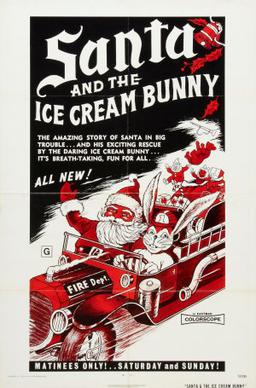
Mahon also had a hand in another special from Pirates World from about two years later called Santa and the Ice Cream Bunny. Several sources have talked about it.

This is the Manos of Christmas specials.

As for Santa and the Three Bears, give it a watch... but stay clear of the DVD releases. Amazon users report skipping.


I'm DLAbaoaqu. Merry Christmas!

Santa and the Three Bears and Santa and the Ice Cream Bunny are owned by... um... whoever picked up the rights after Pirates World folded.

Sunday, November 23, 2014

SPECIAL REVIEW: The Thanksgiving That Almost Wasn't (1971)

"Because of you two, I almost ended up in that big acorn tree in the sky!"

Last time, I revisited a somewhat obscure Thanksgiving special that I had only seen in the first grade. This time around, it's off to something more people have seen: The Thanksgiving That Almost Wasn't. Back in the 90's Cartoon Network played the heck out of this special when November rolled around; nowadays, not so much. You can probably catch it on Boomerang or something, but I can't make any guarantees.

The last review, The Mouse on the Mayflower, came to us from Rankin-Bass. This one comes from Hanna-Barbera.

Scrappy... Scrappy... Scrappy... he's not in there. We're safe.
(Two Fred Flintstones*, though.)
Yes, Hanna-Barbera. Spawned at MGM, dominated TV animation in the Dark Age, and absorbed by Time-Warner! Some animation enthusiasts (one being my guest, maniacaldude, from my Fraidy Cat review), would consider it a mere baby step up from Filmation's works. But for better or worse, its made its mark on the industry. On one hand, it's the company that unleashed Scoobysploitation on the world and invented the looping background. One the other, it made syndicated cartoons (and to some extent, anime) possible.

With all that out, let's get into the special.

SUMMARY
(SPOILERS AHEAD!)


We start with a boy and his sister (who sounds a little too old) about to enjoy a Thanksgiving dinner with their parents. At the same time, a family of three squirrels (with the youngest played by June Foray... and no, this isn't Rocky) about to celebrate the holiday as well. Why would a bunch of animals celebrate a human holiday? Well, the squirrels have an ancestor who was involved with the first Thanksgiving! Surprise!

The father squirrel goes over the basic history of the founding of Plymouth Plantation: the voyage of the Mayflower, the hardships of the first months in the New World, meeting the Wampanoag (here, true to history, they don't meet the boat!), et cetera.

The squirrel's forefather, Jeremy, was living in a tree at the settlement. Close to his tree was a cabin belonging to a boy called Johnny Cook and his family. Just like in the last special, the Pilgrims were British... but lack accents.

I didn't know Fred Jones from Scooby-Doo had
ancestors who came over on the Mayflower!
Johnny goes out into the forest with a toy gun and mistakes a Wampanoag boy for a turkey (who mistakes Johnny for a turkey as well). They get into a fight and Jeremy has to come down and resolve the argument. He tells them that they should be friends. The squirrel goes up them and speaks to the boys directly. They don't question it or run back to the village or anything.

What rules apply here? We've established that animals can talk to other animals, what about here? Can the boys understand Jeremy because they're younger?

Of course, the two boys patch things up. The native boy introduces himself as Little Bear...


Wrong Little Bear and you know it! Pre-K stuff will have no presence on this blog!
Besides, this show's from 1971.

The weird thing about the whole sequence? A minute ago, during Papa Squirrel's summary of the traditional Thanksgiving tale, we saw the two boys together gigging for fish in a stream:

I guess they didn't say anything during this time and forgot who they
were in a few months.

Finally seeing eye to eye, LB and Johnny go back to the settlement and we get an extension of the special's theme song. This sequence also showcases the relatively small amount of footage HB had for it. We are shown two sets of three Puritan ladies carrying cauldrons around, turkeys roasting on a spit (with the background being the only thing that changes), kettles warming over a fire, all shown no less than twice during the sequence. We also get an alternate version of the intro when we hit the second half!

Obviously, it was filler. But then again, this is a Dark Age special and they needed more singing. Still, pretty good party considering that none of the settlers wanted to do anything for their first few months in North America.


Time for another history lesson. When Plymouth first started out, it was practically a socialist state. Before Karl Marx was even a thought, Governor William Bradford wanted all the settlers to make a common pool for all goods made there to be used by all the colonists when they needed it. Bradford wrote of the results of this method in his account, Of Plymouth Colony:
The experience that was had in this common course and condition, tried sundry years and that amongst godly and sober men, may well evince the vanity of that conceit of Plato's and other ancients applauded by some of later times; and that the taking away of property and bringing in community into a commonwealth would make them happy and flourishing; as if they were wiser than God. For this community (so far as it was) was found to breed much confusion and discontent and retard much employment that would have been to their benefit and comfort. For the young men, that were most able and fit for labor and service, did repine that they should spend their time and strength to work for other men's wives and children without any recompense. The strong, or man of parts, had no more in division of victuals and clothes than he that was weak and not able to do a quarter the other could; this was thought injustice.
Basically, when something had to be done, people tried to weasel their way out of work. After all, what was in it for them? Why put effort into a single project when others were also working on it and you could opt out and still reap the same benefits? The winter of 1620/21 was called the "Starving Time" by Bradford and the socialized economy of Plymouth was gradually phased out by the introduction of private property. Only when they had land of their own, the Pilgrims were able to put the stuff they'd learned from the Native Americans to optimal use and prosper.

"This had very good success," wrote Bradford "for it made all hands industrious, so as much more corn was planted than otherwise would have been." 


Amid the revelry, Johnny and LB run off into the forest, pretending to be hunters; naturally, Jeremy tries to get the two back to Plymouth Plantation before they get lost. He, instead, gets stuck in a small log. The two boys' absence gets noticed by the people at the feast; it gets cancelled and search party is sent out to find them.

The boys get lost and eventually reach a river. They try to take it downstream, thinking the colony is down that it... only to almost go over a waterfall! Quick thinking by Jeremy gets the two to dry land, where the squirrel chews them out for almost getting him killed. Getting his bearings straight, the squirrel points the two back toward Plymouth.

The duo sings a song (with the BGM using a duck call as an instrument) while strutting aimlessly through the woods and crossing the same stream twice. Jeremy tells them that going back to Plymouth on their own is a stupid idea an calls in a bunch of his animal buddies to babysit them while he scurries off to find some adults.

In the meantime, the two boys play hunter again (under animal supervision) and run into a wolf!

...

Holy crap! This isn't just a Thanksgiving special... it's Jonny Quest, 1621!


Think about it! You've got a blond-haired Caucasian protagonist...


...his Indian friend (Native American and Oriental, for the respective versions)...


...and their animal companion!


Even the father of the first boy listed has red hair!

And that says nothing about the constant life-threatening scenarios both groups of kids consistently find themselves in! 

And nobody noticed this after forty-plus years?

Anyway, with a wolf out trying to kill the boys, Jeremy's animal friends take action against the beast. Sparrows dive! Porcupine needles are launched like rockets! Rocks and acorns are hurled!

At the same time, Jeremy finds the search party and tells them where the boys are... in Squirrel. What would this accomplish? He spoke to the boys in English, but his words are basically "Jrbbl! Jrbbl! Gblubub!" here.

The wolf corners LB and Johnny. LB uses his bow on it, but the arrow seems to be just a toy since it bounces off the beast's snout. The search party attempts to shoot it with a musket, but fears that the gun would hit one of the boys. Fortunately, Jeremy bites the wolf's tail, shifting its attention to him. He tricks its into a hollow log, where it gets stuck!

With LB and Johnny safe, the festivities resume and Jeremy is made the guest of honor! He sings a song in honor of what all they were able to have and is joined in each verse by the two boys. This begs a question: is Jeremy singing in Squirrel or English? Given just a few scenes back, he was speaking to the search party in Squirrel. Will they understand him here, or just LB and Johnny?

"For if it hadn't been for him," says Papa Squirrel "there never would have been a Thanksgiving." I dunno, the mouse living in the steeple of Siloam Presbyterian Church over on McElveen Avenue may dispute your claim.

The squirrels eat their meal and the son wishes that Jeremy were alive to join them. Little does he know, that painting of his forefather is haunted by his spirit!

Ba, ba, BAAAAA!!


VERDICT

After doing The Mouse on the Mayflower, I knew I had to take a look at this one. It's only half as long, but it tells its own story rather than have the whole thing reenact the Mayflower's journey across the Atlantic and the founding of Plymouth Plantation. A lot of great voice talent is brought in and even some of the animation is pretty good considering the time and studio (like one shot of the wolf running at an angle and the smoothness of the boys' walking through the woods). The depiction of the Native Americans as non-stereotypes via Little Bear probably helped this special last a little longer in the modern consciousness than in Mouse.

Hanna-Barbera, yes, was low budget, but sometimes they got creative. One example I can think of right off the bat: the use of Jeremy rolling a boulder up a small tree to bend it over to prevent the boys from going over the waterfall. They had Jeremy moving on a flat plane, but rotated the background. Better than having Little Bear or Johnny saying "Look! Jeremy bent that tree down!" when it happens offscreen.

The weakest point for this special, I believe, is the songs. There were only three, but they were all pretty forgettable. Two of them, "Let's Take the Shortest Road Home" and "It's a Wonderful Day To Say Thank You" were pretty flaccid, yet the former was fluffy enough for my tastes. It also seemed as if they were hoping that "Dinner on the First Thanksgiving Day" was going to take off and become THE song for the holiday; it was played three times: the intro, the cooking montage, and the credits. Of course, if HB did try to attempt another Thanksgiving special, they'd probably reuse it... just like they did with their original Christmas carols.

After all is said and done, TTTAW is a pretty good special when you consider its age. When Turkey Day rolls around, try to YouTube it, it's worth your time this season.


I'm DLAbaoaqu. Happy Thanksgiving to my readers in the US.


*The "Fred" in the trenchcoat is a spy who just so happened to look like the real one. The movie was A Man Called Flintstone. I saw it a couple of times on Cartoon Network's Cartoon Theater back in the late 90's.


Sunday, November 2, 2014

SPECIAL REVIEW: "Mouse on the Mayflower" (1968)


Autumn, 1993. A much younger DLAbaoaqu was in the first grade. He and his class were shown a VHS tape shortly before Thanksgiving break. It was a little cartoon about a mouse that traveled with the Pilgrims to the New World and participated in the settling of Plymouth Colony. He vaguely recalled the mouse living in a church and a bunch of sailors (plus one Indian) trying to ruin the new holiday.

The special would never cross my mind again for twenty years. When it finally did, a Google search revealed its title: Rankin-Bass' The Mouse on the Mayflower.

I haven't touched on Rankin-Bass yet, but my friend maniacaldude from last time considers its stop-motion efforts (codified by the Rankin-Bass Christmas Special Universe) to be some of the lowest quality he's ever seen. But I'm probably not going to delve into that stuff here (as far as I know). Instead, I'm planning on sticking with RB's traditional animation.

All that out of the way, let's find out if this special is a pearl trampled under countless football games... or just another turkey.

SUMMARY


We open at a church in the late 1960's, whose belfry is home to our narrator -- a mouse called William. His forefather, Wilhelm, boarded the Mayflower back in 1620 and was present at the founding of Plymouth Colony. William reads us Wilhelm's account of those events.

We start in England, where the Puritans are gathered together at their church. Of course, people didn't understand their customs... but the worst thing that King James I and his supporters ever do is hurl tomatoes at the church door.

Wilhelm goes on to talk about the members of the congregation: we have William Bradford, Miles Standish (who was actually a Stranger), an original character called Charity Blake, John Alden, Priscilla Mullins, and (finally) Wilhelm himself.

With the historical figures, the character designers did a pretty good of replicating their appearances:

JOHN ALDEN
MILES STANDISH

William Bradford on the other hand, has merged with Reverend William Brewster, took his job, shaved, and became a stock Pilgrim:


Bradford announces that, since everyone's tired of being treated like dirt by the king, they're all going to move to Virginia and start a colony there. It would seem that the stuff about their financial and ideological troubles in Holland and the issues with the Speedwell aren't being discussed (either for time or other matters), so they just cut to the boarding of the Mayflower on September 6, 1620.


As the Saints and Strangers (okay, this version was dumbed down... there are no Strangers in this telling) board, we are shown our subplot for this special: the love triangle between Miles Standish, John Alden, and Priscilla Mullins. Here, Alden is depicted as pretty much Standish's whipping boy instead of one of the ship's coopers. Of course, Standish does get a little owned on his end and has to take care of a chicken:

 To think that Bright Noa would get it worse centuries later...

When Bradford shows the captain (accurately identified as Christopher Jones) the chest with the money to finance the trip, we meet two of the villains of the special: the sailors Scave and Quizzler. Seeing the gold used to pay for the trip, the twosome plan on stealing it for themselves should a disaster befall the ship.

The weird part of this? They're the only two characters with British accents; despite Bradford, Standish, Jones, Alden, and the rest of the Mayflower's passengers and crew historically originating in England, they all sound American.

Where is Wilhelm in all this? He overslept... but he makes the ship. By shoe:


As the Pilgrims adjust to their cramped life on the Mayflower, the ship enters a storm with thunderless lightning. Seriously, bolts with no noise to follow.

Amid the pitch of the Atlantic waves, a beam cracks, threatening the ship's frame. The two sailors try to use this as a way to make off with the gold, but Wilhelm leads Standish into the hold (by stealing a medal off of his chest). Standish finds the broken beam and tells the sailors to warn the passengers; Quizzler tells him it's none of their business... and Standish up and SLAPS the dude across the face!

Words don't describe the awesomeness of this scene. Just watch:

No-nonsense attitude.
British with no accent.
Now slapping people.
You ARE the 17th Century Bright Noa.

As history tells us, the beam was repaired because of a "great iron screw" (reportedly of a printing press owned by Brewster, but others have suggested a building tool used by the passengers)... only here, they came up with the idea through Wilhelm! Standish congratulates Wilhelm for his ingenuity, though HOW he knew his name is a mystery.

After the storm passes, we return to our love triangle. Alden tries to pass on Standish's messages to Priscilla, but gets shoved away by Ms. Blake. Other than to remind the viewer that they're still in the story, it serves as a segue to a musical number... but we'll get into those after the summary.

The Mayflower finally reaches the coast of North America. But surprise! They're not at Virginia... it's New England! With winter coming on, the passengers were left with no choice but to start a colony there.

This is only partially accurate to history: Mayflower's destination was Virginia, but Virginia (at this time) stretched as far north as New York state. The first bit of North American soil the Pilgrims ever saw was Manhattan Island. They attempted to settle there, but the shoals proved to be too big a risk. The Strangers, those who boarded the Mayflower for non-religious reasons, wanted to mutiny when the ship went to New England. Because of this, some ground rules had to be set down which leads us to the next point in the special.

With preparations for a settlement underway, a binding document was written up for all passengers on the ship to sign. At only one-hundred ninety-six words, this document -- the Mayflower Compact -- would allow for a temporary period of self-government until the Virginia Company could get permission for the Puritans to permanently live there from the Council of New England. Of greater significance, the document would be the forerunner to the Constitution of the United States.

Of course, Wilhelm signed it in the special as well.

In our reality, the original Mayflower Compact is lost. Whether it was through a fire or the American Revolution, we may never know.


The one of this universe was in our narrator's possession inside of a random American church.

Back to the special.

The story bypasses the surveying of Cape Cod and skips to the landing at Plymouth Rock. Here, Alden relays another message to Priscilla from Standish. She clearly isn't interested in him and Alden has the upper hand in the triangle... but he can't really bring himself to admit his love for her.


Meanwhile, Wilhelm encounters a Native American mouse called Little Big Thunder and the two quickly become friends. How a rodent can identify with a human ethnicity is beyond me... but I think some obscure SJW will come out of the woodwork to call me dumb for "just not getting it".

With another mouse around, we finally can hear Wilhelm talk. Unfortunately, Thunder's syntax is that of the old, trite "You heap big chief?" thing. It's quite dated and a trifle unsettling, I'll give it that... but it's not something that would make me put an unskippable, ultra-PC disclaimer telling you stuff you should already know between the article link and this review.

Anyway, Thunder's new friendship with Wilhelm brings the Wampanoag into the picture, several months ahead of history.


We then get introduced to the third villain of the story: Smiling Buzzard. This violent soul quickly gets excommunicated from the Wampanoag Confederacy and wanders into to the wilderness, where he summons a grizzly called Big Wheeze. The bear, according to Wilhelm's account, wandered out of Canada and came to Cape Cod.

"The part of Big Wheeze will be played by Baloo!"

It doesn't take long before the villains of the Eastern and Western Hemispheres bump into each other (apparently, bad guys can detect one another via their noses) and form an alliance.

The Wampanoag come across the Puritans during a prayer meeting. Yeah, no Samoset to greet them in English; a whole bunch of them just waltz up and try to get a closer look.

As for our four villains, they attempt to make it seem like the Wampanoag killed Quizzler in order to provoke a massacre. The mice catch onto to what the group was trying to do and perform a pantomime act to tell the Puritans and Natives to be friends. It worked for Standish.

As for bad guys, their cover was blown by Ms. Blake's chicken, which showed that Quizzler was playing possum. Standish proceeds to chase the foursome away with his musket. They headed due west, never to be seen again in this special. I'd like to think that they tried to make their own settlement on the other side of the Appalachians... but it eventually died out being as the population was three men, a bear, and no women.

A pineapple? Must have cost an arm and a leg for Massasoit!

With the Puritans now on friendly terms with the Wampanoag, they begin building their town. But snow starts falling. Thus starts the deadly winter of 1620/1621, where the population was slashed dramatically.

Amid Wilhelm's grieving, he finds newly-sprouted wildflowers, which he shows to Bradford. Winter has passed, and the colony starts to turn around. By autumn, the Plymouth Plantation has an abundant amount of food, so much so that Wilhelm suggests inviting Thunder to the festival... something quickly extended to the Native Americans. If you don't know where this is going, you probably need to brush up on your American History and culture.

Finally, the Standish/Priscilla/Alden triangle is resolved during another relay. Priscilla, fed up with Alden being Standish's messenger boy, demands that he speaks for himself for a change. Thus, the future is guaranteed Presidents John Adams and John Quincy Adams, former Vice President Dan Quayle, Henry Wadsworth Longfellow, Orson Welles, Marilyn Monroe, and much, much more! Eventually Standish's genes would enter into the bloodline and produce Dick van Dyke!

No, really. The people listed here are really John Alden and Priscilla Mullins' descendants.

The first Thanksgiving goes over quite well and thus the ground is broken for what would eventually become the United States. Oddly enough, Wilhelm could understand how it became a national holiday -- something that never took place until the Lincoln administration. Was he immortal or something?

THE END


VERDICT

Not exactly stellar in terms of animation quality, but it was okay for 1968. Looking at the art style, I'm reminded of Scooby-Doo, what with all the eyes that match everyone's skin and it hitting the airwaves one year before. Only the animation wasn't done by Hanna-Barbara, it was outsourced to Toei Animation. Y'know... the Dragonball series, Digimon, Voltron, One Piece?

Of course, there were mistakes made in regard to research. Some stuff was only partially correct and other events were moved around at the expense of the plot. For instance, if the Wampanoag had met the Puritans on good terms in 1620, where were they during the deadly winter at the start of the following year? The script could have used just one more revision.

Historically inaccurate? Yes, but it's not the most grievous case (believe me, we will get into worse stuff in the future).

But where this special shines brightest is the music. Some songs reminded me so much of RB's latter Tolkien cartoons, be it the rousing title ("Mayflower, Mayflower"), the upbeat song where Wilhelm tries to get situated on the ship ("How About A Little Elbow Room?"), or the grandiose recurring piece "November". It helps that Wilhelm and the narrator were played by Country-Western artist Tennessee Ernie Ford (say what you will about RB's overall animation quality, they pulled in some excellent vocal talent).

Also, we have a song for Priscilla Mullins: "When He Looks At Me". It feels so Bond-esque and is peppered with psychedelic imagery (which is a point in this special's favor from me... I like that stuff). It also has some Disney shout-outs, specifically to Cinderella.

All-in-all, it's pretty good for small kids... but if you're into the facts, it may not be for you (except from a point of bile fascination, maybe). If I may make a recommendation, track down the Pilgrims episode of This Is America, Charlie Brown. It's noticeably shorter than this special and a lot more accurate.


Hmm... I brought up Hanna-Barbara in this verdict.


I'm DLAbaoaqu and I'll Return!

Mouse on the Mayflower (1968) is owned by Time-Warner.
Anastasia (1999?) is owned by Dingo Pictures.
Mobile Suit Gundam ZZ (1986) is owned by Sunrise.